
Modern IT teams are under constant pressure to deliver faster without sacrificing stability. This guide breaks down the essential tools across every stage of the DevOps lifecycle—from planning and code creation to testing, deployment, and production monitoring. Many projects stall due to disconnected workflows and manual handoffs, but integrating tools like Git, Jenkins, Docker, Kubernetes, and Prometheus can transform speed and reliability. You’ll learn not just what these key DevOps tools do, but why they matter and how they connect to form a seamless, automated pipeline that accelerates releases, reduces errors, and drives true operational efficiency.
The Foundation: Source Code Management and Version Control
Every solid DevOps practice begins with a single source of truth—a centralized, authoritative repository where all code and configuration live. Without it, teams rely on scattered files, shared drives, or “finalv3really_final” folders (we’ve all seen them), which leads to confusion and costly mistakes.
A Version Control System (VCS) is software that records changes to files over time, allowing teams to track who changed what, when, and why. This matters because modern development is parallel by default. Multiple developers work on different features simultaneously, and VCS platforms prevent conflicts through structured branching and merging workflows.
Git, the distributed version control standard, allows developers to clone repositories locally, create feature branches, and merge updates safely. Hosted platforms like GitHub, GitLab, and Bitbucket extend Git with pull requests, code reviews, issue tracking, and integrated CI/CD pipelines—turning repositories into collaboration hubs.
Critics argue smaller teams don’t need such structure. But even two developers editing the same file can overwrite each other’s work. Version control protects integrity, enables safe rollbacks, and anchors all essential DevOps tools to a reliable foundation.
Automating Quality: Continuous Integration (CI) Platforms
Continuous Integration (CI) sounds complex, but the idea is simple: every time a developer pushes code to a shared repository, an automated system builds and tests it immediately. In other words, instead of waiting until the end of a project to see what breaks, you find out within minutes. That fast feedback loop is the heart of CI.
So why does this matter? Because integration issues multiply quickly. When multiple developers modify the same codebase, small conflicts can snowball (like assembling IKEA furniture without the manual). CI platforms automatically run test suites—collections of predefined checks that verify code behaves as expected—keeping the main branch stable and deployable.
Some argue CI slows teams down with constant testing. However, research from DORA reports shows high-performing teams that adopt CI/CD practices deploy more frequently and recover from failures faster (Google Cloud, 2023). Early detection simply costs less to fix.
Popular essential DevOps tools include Jenkins, GitLab CI/CD, and CircleCI—each automating builds, tests, and pipelines to streamline modern development workflows.
Building Repeatable Systems: Infrastructure as Code (IaC)
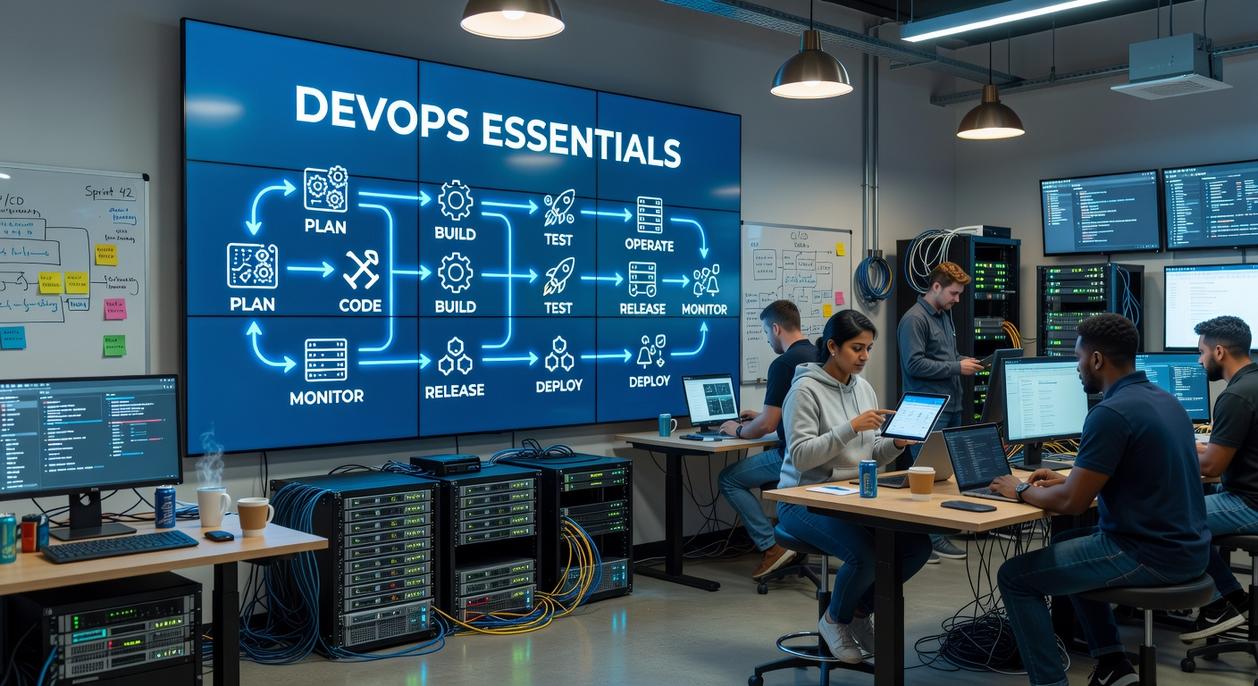
Infrastructure as Code (IaC) means managing servers, networks, and databases using machine-readable files instead of clicking around in dashboards. In simple terms, your infrastructure becomes code. If software code defines how an app behaves, IaC defines how the environment behaves.
Why does this matter? Because manual setup leads to configuration drift—when environments slowly become different from one another over time (and yes, that’s how the classic “but it works on my machine” saga begins). IaC eliminates that by letting you spin up identical environments on demand.
It also introduces version control, automation, and repeatability—the same principles that power essential DevOps tools. If you’re familiar with APIs, this connects closely to understanding apis the backbone of modern software: https://susbluezilla.com.co/understanding-apis-the-backbone-of-modern-software/
Key tools simplify the process:
- Terraform: Uses declarative syntax to describe your desired infrastructure end state.
- Ansible: Agentless automation for configuration and deployments.
- Pulumi: Define infrastructure using Python, Go, or TypeScript.
Think of IaC as a blueprint you can rerun anytime—predictable, portable, and scalable.
Containerization and Orchestration: The Modern Deployment Stack
At its core, containerization means packaging an application with all its dependencies—libraries, runtime, system tools—into a lightweight, portable unit called a container. Think of it like a shipping container for software: no matter the port (cloud, on‑prem, laptop), the cargo arrives intact. As a result, the classic “it works on my machine” excuse starts to disappear.
Why Orchestration Changes Everything
However, running one container isn’t the challenge—running hundreds is. That’s where orchestration comes in. Orchestration tools automatically deploy, scale, restart, and network containers across clusters of machines. Docker remains the standard for building containers, while Kubernetes (K8s) dominates large-scale automation.
Some critics argue virtual machines already solved portability. Fair point—but containers are faster to start, lighter on resources, and better suited to microservices architectures (Netflix-scale systems don’t reboot VMs for fun).
Looking ahead—this is speculation—container orchestration will become increasingly autonomous, blending AI-driven scaling with policy-based security. In short, mastering these essential DevOps tools won’t just be helpful; it may soon be table stakes.
Closing the loop in DevOps means turning raw production data into real-time, decision-ready insight. Monitoring tracks metrics (numerical performance data like latency or CPU usage), logging captures discrete event records, and observability connects the dots so you can ask new questions without redeploying code. This feedback loop validates releases and shrinks incident response from hours to minutes.
Competitors often stop at dashboards. The real edge is correlation: tying metrics, logs, and traces to business impact—like revenue dips during API slowdowns (yes, that happens more than teams admit).
- Prometheus & Grafana
- ELK Stack (Elasticsearch
Logstash
Kibana): A popular solution for centralized log aggregation, search, and analysis.
Pro tip: Alert on symptoms users feel, not just infrastructure thresholds.
Build a DevOps Pipeline That Actually Delivers
You set out to understand what it really takes to assemble a high-performance DevOps toolchain—and now you can see that success isn’t about stacking random tools together. It’s about eliminating friction, accelerating delivery, and creating a seamless path from commit to customer.
The real pain point isn’t lack of tooling. It’s disconnected systems, manual handoffs, and bottlenecks that slow innovation. If your pipeline still feels clunky, that’s your signal.
Start by pinpointing your biggest workflow constraint and fix it first. Then iterate. High-performing teams build incrementally, automate relentlessly, and measure everything.
Don’t let inefficiencies stall your releases. Take action today—optimize your pipeline, streamline collaboration, and turn your DevOps process into a competitive advantage.