
Technology evolves faster than most teams can document it. If you’re here, you’re likely looking for clear, actionable insight into the latest tech developments—whether that’s understanding emerging software platforms, evaluating machine learning frameworks, or optimizing system performance without getting lost in hype.
This article delivers a focused breakdown of today’s most relevant tech pulse highlights, core concepts that actually matter in production environments, and practical optimization strategies you can apply immediately. Instead of recycling surface-level trends, we analyze real-world implementations, performance benchmarks, and architectural trade-offs to help you make informed technical decisions.
Our insights are grounded in hands-on evaluation of modern tools, close review of platform documentation, and continuous monitoring of ecosystem shifts across infrastructure, AI, and software engineering. The goal is simple: give you clarity on what’s changing, why it matters, and how to use it to build smarter, faster, and more resilient systems.
Taming Complexity: A Blueprint for Robust System Design
Senior engineers often leverage their deep understanding of complex systems to craft robust architectures, which makes exploring the intricacies of APIs—fundamental to these designs—an essential next step for anyone interested in modern software development – for more details, check out our Understanding APIs: The Backbone of Modern Software.
As systems scale, complexity spreads like ivy on a brick wall—quiet at first, then impossible to control. Features multiply, dependencies tangle, and reliability erodes. The real enemy isn’t ambition; it’s unmanaged growth.
This article solves that by replacing guesswork with complex system design principles that prevent brittle, unscalable architectures. Think of it like city planning: without zoning laws, traffic rules, and infrastructure layers, chaos wins.
From real-world platform and ML framework builds, one truth stands out:
- Design for failure, not perfection
- Separate concerns early
- Optimize feedback loops
Because resilience isn’t accidental—it’s engineered.
Principle 1: Embrace Modularity and Strict Encapsulation
First, let’s define modularity. Modularity is the practice of breaking a large system into smaller, independent, and interchangeable components called modules. Instead of building one giant, tangled codebase (the software equivalent of a junk drawer), you design focused pieces that each solve a specific problem.
Closely related is encapsulation—the concept of hiding a module’s internal state and complexity while exposing only a clear, well-defined interface, often through an API (Application Programming Interface). In other words, other parts of the system can interact with a module, but they can’t see—or interfere with—its inner workings.
Think of each module as a “black box.” The rest of the system knows what it does, but not how it does it. Much like using a streaming app without knowing its recommendation algorithm (thankfully), this separation allows developers to change internal implementations without breaking dependent components.
Now, some argue strict encapsulation slows development. After all, wouldn’t direct access to everything be faster? In the short term, maybe. However, in complex systems, tight coupling creates fragile dependencies that shatter under change. Modularity, by contrast, aligns with Use complex system design principles and reduces cascading failures.
For example, consider a user authentication service. Internally, it manages password hashing, token generation, and session storage. Externally, it exposes simple functions like login() and logout(). The application doesn’t care how authentication works—only that it works. That separation is what keeps systems resilient as they evolve.
Principle 2: Master Separation of Concerns (SoC)
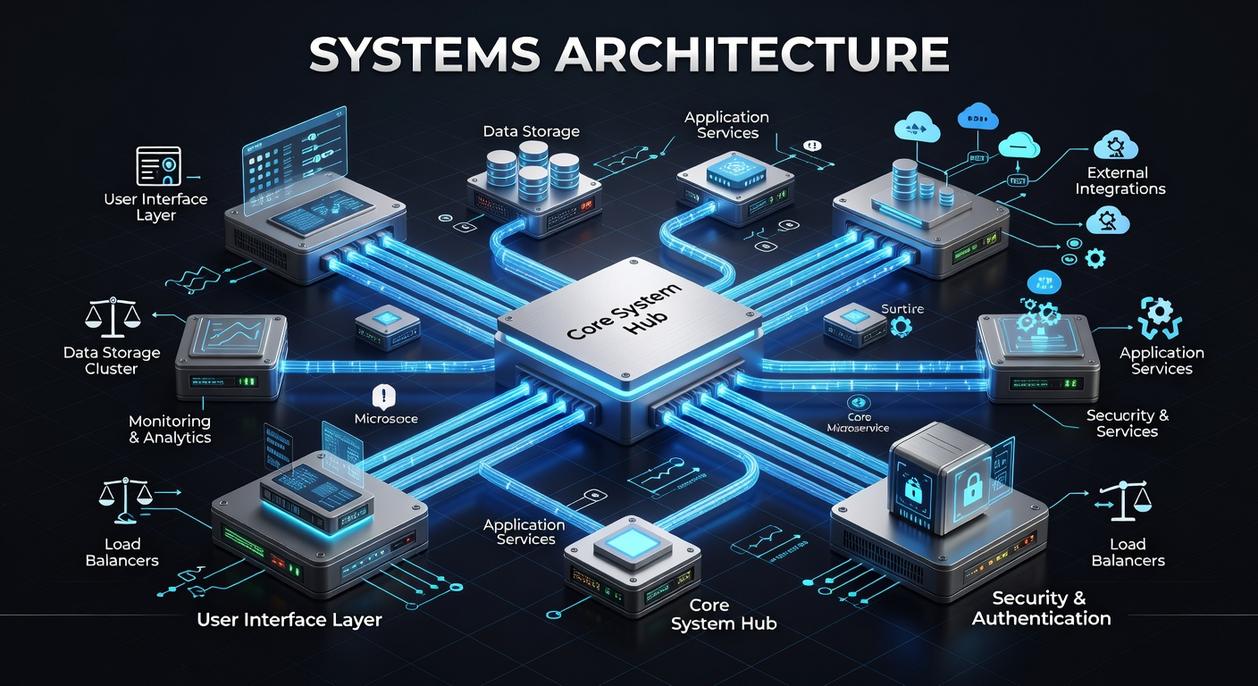
Separation of Concerns (SoC) is a design principle that structures a system into distinct sections, where each section handles a specific responsibility. Instead of blending database queries, business rules, and user interfaces into one tangled codebase, SoC isolates them into clearly defined layers. The result? Cleaner architecture and fewer “why did this break everything?” moments.
It’s often confused with the Single Responsibility Principle (SRP), but they operate at different scales. SoC is macro-level architecture—think dividing an application into data, logic, and presentation layers. SRP is micro-level design—ensuring a single class or function has only one reason to change. One shapes the system; the other refines its building blocks.
Why It Matters
- Reduced complexity: Smaller, focused components are easier to reason about.
- Improved maintainability: Updates stay localized instead of rippling unpredictably.
- Parallel development: Teams can work independently on UI, backend logic, or data systems.
Consider a web application:
- The data access layer manages database queries.
- The business logic layer enforces rules and validations.
- The UI layer presents information to users.
If the database changes, the UI doesn’t need rewriting—only the data layer adapts. That containment is the practical power of SoC.
Pro tip: document layer boundaries early. It prevents accidental cross-layer shortcuts later.
To build resilient platforms, teams must Use complex system design principles deliberately—and SoC is foundational among them.
Principle 3: Design for Failure and Resilience
Early in my career, I treated outages like personal failures. If something broke, I assumed I hadn’t engineered it well enough. So I overcorrected—adding validations, tightening controls, trying to eliminate every possible fault. It didn’t work. The system still failed. Just in more surprising ways.
The real shift came when I embraced Design for Failure and Resilience. Instead of preventing every issue, you assume components will fail—and plan for graceful recovery. In distributed environments, that’s not pessimism. It’s reality.
Key Resilience Patterns
-
Redundancy: Duplicate critical components so backups take over seamlessly. Think multiple server instances behind a load balancer. When one crashes, users barely notice (like swapping a flat tire without stopping the race).
-
Circuit Breakers: If a service starts failing, stop sending requests to it temporarily. This prevents cascading failures across the system—like tripping a breaker before the whole house loses power.
-
Graceful Degradation: When a non-critical feature fails, the core system keeps running. If a recommendation engine goes down, customers should still complete checkout.
I once skipped a circuit breaker in a payment integration to “simplify” the architecture. A minor slowdown turned into a full outage. Lesson learned: resilience isn’t optional.
These ideas sit at the heart of cloud-native architectures, microservices, and sound complex system design principles. They’re also among the key skills every modern software architect needs.
Principle 4: Decouple with Asynchronous Communication
Decoupling means reducing the dependencies between components so a change or failure in one has minimal impact on others. In tightly connected systems, one glitch can ripple outward like a bad Wi‑Fi signal in a crowded café (we’ve all been there).
That’s where asynchronous communication comes in. By using message queues or event-driven architectures, services exchange messages without needing to be live at the same time. A publisher sends work to a queue; a subscriber processes it when ready.
The benefits are immediate. You can absorb traffic spikes by queuing requests instead of crashing. If a downstream service fails, the upstream service keeps running. In complex system design principles, this separation boosts scalability, resilience, and operational flexibility—so your system grows without growing fragile.
Building durable software isn’t about chasing a flawless master plan; it’s about applying enduring complex system design principles every single sprint. When teams ignore modularity, separation, resilience, and decoupling, they pay in brittle releases, ballooning costs, and late‑night firefights (the kind that make pizza boxes a permanent desk accessory). Some argue speed matters more than structure. Short term, maybe. Long term, NEVER. My recommendation: start small. Apply one principle to your next feature and measure the clarity gained.
- PRIORITIZE CLEAR BOUNDARIES
- Reduce hidden dependencies
Pro tip: document decisions immediately. Stability compounds. Future changes become easier and cheaper dramatically.
Mastering Modern Tech with Confidence
You came here to make sense of today’s fast-moving tech landscape — from emerging software platforms to machine learning frameworks and smarter system optimization strategies. Now you have a clearer view of how these innovations connect and how applying complex system design principles turns scattered tools into scalable, high-performing ecosystems.
The real challenge isn’t access to information. It’s cutting through the noise, understanding what actually matters, and implementing solutions without wasting time or resources. Falling behind on architecture decisions, optimization strategies, or framework adoption can cost you performance, stability, and competitive edge.
The next step is simple: stay plugged into reliable tech pulse insights, apply what you’ve learned to your current systems, and proactively refine your architecture before bottlenecks appear.
If you’re serious about building faster, smarter, and more resilient systems, tap into the #1 trusted source for actionable tech breakdowns and system optimization strategies. Explore the latest insights now and start designing systems that scale with confidence.