Modern distributed systems often feel like black boxes. When something breaks, traditional alerts might tell you a service is down—but not why it failed or how the issue cascaded across dependencies. That reactive approach slows teams down and turns every outage into a firefighting exercise. This is where observability changes the game. By enabling teams to ask deeper, open-ended questions about system behavior, observability reveals the interconnected causes behind failures—not just the symptoms. In this guide, you’ll learn the core principles behind effective monitoring and observability tools, the technologies that power them, and how to build a stack that shifts your team from reactive alerts to proactive insight.
Beyond Basic Health Checks: Monitoring vs. Observability
First, let’s clarify terms. Monitoring focuses on known unknowns—predefined metrics and logs that track expected failure modes. It answers questions like, “What’s our current CPU usage?” Think of it as your car’s check-engine light. Helpful, yes—but limited.
Observability, on the other hand, tackles unknown unknowns. It’s a system’s ability to let you explore behavior you never anticipated. If monitoring is the warning light, observability is the mechanic’s full diagnostic toolkit tracing the fault to a single bad sensor.
Some argue monitoring alone is enough (after all, it’s simpler and cheaper). However, modern distributed systems fail in unpredictable ways. Relying only on dashboards is like debugging blindfolded.
So here’s my recommendation: invest in monitoring and observability tools together. Start with critical metrics, then layer tracing and rich logs. For practical steps, review how to optimize application performance for high traffic. In short, don’t just detect problems—understand them.
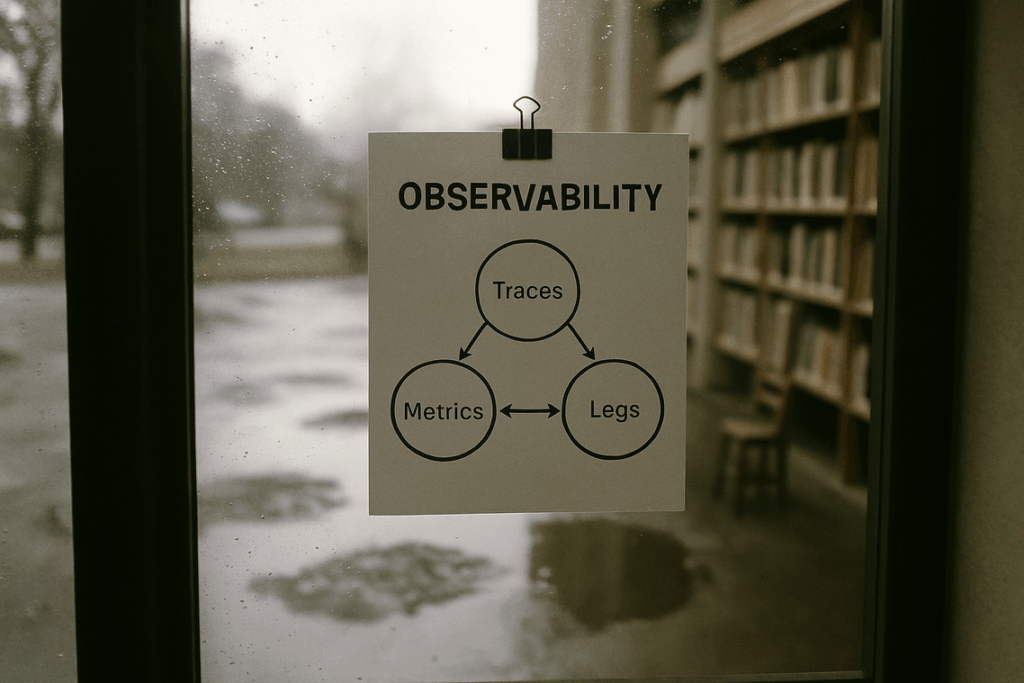
The Three Pillars of Observability: Logs, Metrics, and Traces

Modern systems fail in creative ways (usually at 2 a.m.). That’s why understanding the three pillars of observability—metrics, logs, and traces—isn’t optional. It’s survival.
Metrics: The “What”
Metrics are numerical, time-series measurements that show system health over time. Think CPU usage, request latency, or error rates. If your API latency jumps from 120ms to 900ms, metrics tell you something’s wrong.
Practical tip:
- Start with the “golden signals”: latency, traffic, errors, and saturation (Google SRE guidance).
- Set alerts on abnormal deviations—not just fixed thresholds.
- Visualize trends on dashboards for fast pattern recognition.
Metrics are lightweight and ideal for proactive monitoring. But they won’t explain why latency spiked.
Logs: The “Why”
Logs are timestamped records of discrete events. For example: “User A failed login due to invalid password.” They provide granular context metrics can’t.
When debugging:
- Filter logs by timestamp during the incident window.
- Search by correlation IDs or user IDs.
- Look for repeating error patterns.
Pro tip: Use structured logging (JSON format) so logs are machine-searchable. It saves hours.
Traces: The “Where”
Traces map the end-to-end journey of a request across services. In microservices architectures, one slow dependency can drag everything down (like one slow checkout line at a supermarket).
Use distributed tracing to:
- Identify bottlenecks
- Measure service-level latency
- Pinpoint failure points
When combined inside modern monitoring and observability tools, these three pillars transform guesswork into clarity. Metrics show the spike. Logs explain it. Traces locate it. That’s how you move from reacting to optimizing.
Unified Observability Platforms: All-in-One Solutions
Unified observability platforms bring metrics, logs, and traces together into one cohesive system. In simple terms, metrics are numerical measurements (like CPU usage), logs are timestamped event records, and traces map the journey of a request through distributed services. Instead of juggling separate dashboards, teams get a single, correlated view—often called a “single pane of glass.”
First, consider Datadog. With 500+ integrations, it connects cloud services, containers, databases, and more in minutes. For example, if your checkout API slows down, you can pivot from infrastructure metrics to application traces to logs in a few clicks. Practical tip: start by enabling out-of-the-box integrations before building custom dashboards—you’ll gain visibility fast without overengineering.
Next, New Relic shines in code-level visibility. Suppose users report lag in a mobile app. You can trace a slow database query to a specific function call and even measure how it impacts conversion rates. In other words, it bridges technical performance with business outcomes (yes, your CFO will care).
Meanwhile, Dynatrace uses its AI engine, Davis, to automate root-cause analysis. Instead of manually correlating alerts, the system maps dependencies and highlights the likely origin of failure. For complex microservices architectures, this dramatically reduces mean time to resolution.
Honeycomb, by contrast, follows a “trace-first” philosophy. It handles high-cardinality data—meaning it captures many unique attributes per request. This is especially useful when debugging unpredictable edge cases in distributed systems.
So how do you choose? Start by mapping your environment complexity and team skill level. Then run a 14-day proof of concept with real incident scenarios. Although some engineers argue specialized monitoring and observability tools offer deeper niche control, unified platforms often win on speed, collaboration, and reduced tool sprawl (and fewer tabs open at 2 a.m.).
Ultimately, the best platform is the one your team consistently uses—and understands.
Building your own open-source stack can feel intimidating, so let’s simplify it. Prometheus is a time-series database (a system that stores data points indexed by time) and alerting engine. It scrapes metrics—numerical measurements like CPU usage—and lets you query them with PromQL, its specialized query language. Grafana sits on top, turning raw numbers into dashboards you can actually read (because staring at logs all day isn’t fun). OpenTelemetry standardizes instrumentation—the code that emits telemetry data—so traces, metrics, and logs flow consistently. Together, these monitoring and observability tools form a flexible foundation you fully control without vendor lock-in or surprises later.
As businesses increasingly adopt advanced monitoring and observability tools for proactive optimization, staying updated on the latest technology trends, like those covered in our article on Technology News Tgarchivegaming, becomes essential for harnessing these innovations effectively.
Choosing the Right Tools for Total System Visibility
System complexity isn’t slowing down—and outdated approaches to monitoring can’t keep up. You came here to understand how to regain clarity in the chaos, and now you know it starts with aligning metrics, logs, and traces to your specific needs. The real challenge isn’t finding more data—it’s eliminating blind spots that cause slow APIs, hidden errors, and costly downtime.
The right monitoring and observability tools will turn guesswork into insight and reactive fixes into proactive performance.
Don’t let uncertainty cripple your system. Identify your biggest pain point today, choose the platform that fits your architecture, and start building a faster, more resilient stack. High-performing teams already are—now it’s your move.