What if you could deploy code without provisioning, scaling, or maintaining a single server? That’s the promise of serverless computing platforms—a cloud model where infrastructure management disappears so you can focus entirely on building features. Traditional server setups are expensive, time-consuming, and often wasteful, forcing teams to pay for idle capacity and handle complex configurations. This article breaks down how cloud-based computing systems that function without the need for dedicated servers actually work, when they make sense, and where they don’t. Drawing on deep analysis of modern software architectures, you’ll gain a clear, practical understanding of this transformative approach.
The term serverless sounds like a magic trick—no servers, no ops headaches. Not quite. Physical servers still power your application, but cloud providers like AWS, Google Cloud, and Azure provision, patch, and scale them for you. The benefit is operational focus: you ship code, they handle infrastructure (and yes, that’s the real win).
At the heart of this model is Function-as-a-Service (FaaS). You deploy small, single-purpose functions that execute one task well—processing a payment, resizing an image, validating a form. These functions live on serverless computing platforms and are designed for precision and speed.
What makes this powerful is the event-driven architecture:
- Functions run only when triggered by an event, such as an API call or file upload.
- They are stateless, meaning no data lingers between executions.
- They scale automatically, from one request to thousands in seconds.
Contrast that with traditional IaaS or PaaS setups, where virtual machines or containers remain always on, accumulating costs even during idle periods. Critics argue serverless reduces control and complicates debugging. Fair point. Yet for variable workloads and rapid deployment cycles, abstraction translates directly into agility and cost efficiency. This flexibility supports experimentation without long-term infrastructure commitments and reduces operational risk.
Core Components of a Serverless Architecture
At the center of any serverless setup are functions—small, single-purpose pieces of code that execute in response to events. Think AWS Lambda, Azure Functions, and Google Cloud Functions. These aren’t full servers humming away in a data center; they’re on-demand compute units that spin up, run your logic, and disappear (like a rideshare for code). In my view, this event-driven compute model is the real magic of serverless computing platforms because it forces cleaner, modular design. Pro tip: keep functions narrowly scoped—one responsibility per function prevents scaling headaches later (AWS, 2023).
Next come event sources, the triggers that wake your functions up. Common ones include:
- HTTP requests (via an API Gateway)
- Database changes (e.g., a new user signs up)
- File uploads to cloud storage (e.g., a new image hits a bucket)
- Scheduled timers (cron jobs)
- Messages from a queue
Some critics argue this event web becomes hard to trace. They’re not wrong—distributed systems add complexity. However, with proper logging and observability tools, the flexibility far outweighs the debugging trade-off.
Finally, Backend-as-a-Service (BaaS) completes the ecosystem. Managed databases like DynamoDB or Firestore, authentication services such as Auth0 or Cognito, and storage options like S3 or Blob Storage remove the need to manage infrastructure. Personally, I think BaaS is what truly unlocks speed; instead of reinventing user auth (again), you plug in proven services. It’s like assembling Lego blocks instead of carving wood from scratch.
If you want a concrete example, explore how AWS Lambda integrates with other AWS services (https://aws.amazon.com/lambda/).
Key Advantages: Why Teams Are Shifting to Serverless

Ultimate Cost-Efficiency
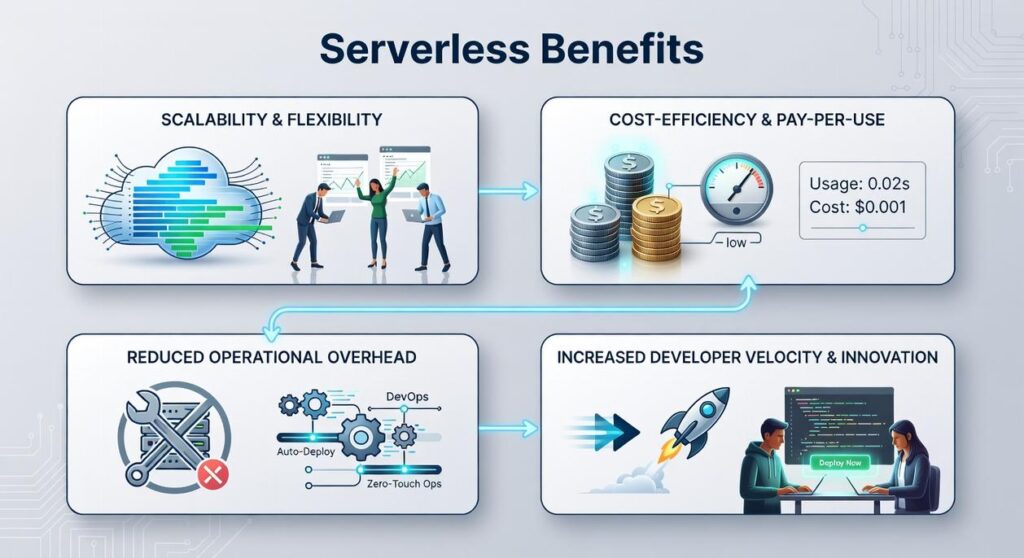
The biggest draw is pay-per-execution pricing. Instead of paying for pre-allocated servers that sit idle (like renting an entire stadium for a pickup game), you’re billed only when your code runs. For apps with unpredictable traffic—think ticket sales during a product launch or a viral social post—this model eliminates wasted spend. Critics argue that high invocation rates can spike costs. That’s true. But with proper monitoring and throttling, most teams still reduce total infrastructure expenses compared to always-on servers (Gartner reports up to 30% infrastructure savings in event-driven workloads).
Automatic Scaling
With serverless computing platforms, scaling is automatic. The system can go from zero to thousands of concurrent requests without manual provisioning. Some engineers prefer hands-on scaling control. However, automated elasticity prevents human miscalculations during traffic surges (remember the launch-day crashes we’ve all seen?).
Reduced Operational Overhead
No OS patching. No server provisioning. No capacity planning. The cloud provider handles it. That frees developers to focus on features instead of firefighting infrastructure.
Faster Time-to-Market
Teams ship faster by building modular functions and integrating managed services. When paired with tools like collaborative development platforms transforming remote teams, deployment cycles shrink dramatically. Pro tip: start with stateless workloads to maximize early wins.
Practical Use Cases and Real-World Examples
If terms like microservices or real-time processing sound abstract, let’s simplify them. Microservices are small, independent pieces of an application that handle one specific task. Think of them like food trucks instead of a giant restaurant—each serves one specialty and can scale independently.
- Microservices & API Backends: In RESTful APIs (a standard way apps communicate over the web), each endpoint can run as its own function. This makes scaling easier and cheaper on serverless computing platforms (you only pay when it runs).
- Real-Time Data Processing: “Real-time” means data is handled the moment it arrives—like IoT sensors sending temperature updates instantly to a dashboard.
- Automated Media Manipulation: Upload a file to cloud storage and trigger automatic image resizing, video transcoding, or OCR (optical character recognition).
- Chatbots & Virtual Assistants: Each detected user intent triggers a focused backend function—like dialog trees, but smarter.
Pro tip: Start small and monitor execution time to avoid surprise costs.
As businesses explore the benefits and limitations of serverless computing platforms, it’s essential to also consider how innovative software solutions like Software Susbluezilla can enhance their cloud strategies.
Shifting Your Focus from Infrastructure to Innovation
You set out to discover whether you could run modern applications without the constant drag of server management—and now you know it’s not only possible, it’s a smarter way to build. The real frustration has never been writing code; it’s been patching servers, scaling infrastructure, and paying for idle capacity. By shifting to event-driven models powered by serverless computing platforms, you eliminate that overhead and align cost directly with usage.
Don’t let infrastructure slow your next release. Start with one event-driven task—like a file upload or form trigger—and deploy it serverlessly today. Embrace the efficiency top engineering teams rely on and build faster, leaner, and smarter now.