If you’ve ever asked what is an API, you’re likely trying to understand how apps, platforms, and systems seamlessly talk to each other behind the scenes. Whether you’re exploring software development, integrating tools, or simply curious about how modern digital services connect, this article is built to give you a clear, practical explanation without unnecessary jargon.
APIs power everything from mobile banking apps to machine learning platforms, yet many explanations either oversimplify the concept or bury it in technical complexity. Here, you’ll get a straightforward breakdown of what an API is, how it works, and why it matters in today’s software-driven world.
To ensure accuracy and clarity, this guide draws on established software engineering principles, widely adopted web standards, and real-world implementation patterns used across modern platforms. By the end, you’ll not only understand the definition of an API, but also how it functions as the backbone of connected technology.
The Restaurant Analogy: A Simple Way to Understand APIs
By grasping how APIs serve as the crucial connectors between different software components, you can also appreciate the importance of efficient Memory Management Techniques for High-Performance Systems, ensuring that these integrations work smoothly and effectively.
If you’ve ever wondered what is an API, think about ordering dinner.
You sit at a table (the client application) and look at a menu. You don’t walk into the kitchen to cook your own pasta. Instead, you tell the waiter what you want. The waiter (the API) carries your request to the kitchen (the server), then brings your food back.
That’s the core idea: an API is a messenger. It takes a request, delivers it to a system, and returns the response.
Breaking Down the Roles
- Client (You): The app requesting data
- Server (Kitchen): The system storing or processing data
- API (Waiter): The structured communication layer
Notice something important: you never see the kitchen. That separation improves security and efficiency. The kitchen doesn’t risk random customers touching the stove (which would be chaos).
A Practical Example
When you open a weather app:
- The app sends a request for your city’s forecast.
- The API forwards that request to a weather server.
- The server responds with temperature data.
- The API delivers it back in readable form.
Pro tip: When testing APIs yourself, use tools like Postman to send sample requests and inspect responses step by step.
Think of APIs as curated menus. You can only order what’s listed—and that’s exactly what keeps systems stable.
How APIs Function: Requests, Responses, and Endpoints
To understand what is an API, you need to see how the request-response cycle actually works under the hood. At its core, an API call is a structured conversation between a client (like a mobile app) and a server.
First, the request. A client sends a message asking the server to do something. This message includes an HTTP method, such as:
- GET – Retrieve data
- POST – Create new data
- PUT – Update existing data
- DELETE – Remove data
For example, a weather app might send a GET request to:
api.weatherapp.com/v1/forecast/london
That URL is the endpoint—the precise location where a specific resource lives. Think of it like a street address for data (no wandering required).
Next comes the response. The server processes the request and returns data, usually in JSON format because it’s lightweight and machine-readable:
{
  "city": "London",
  "temperature": "12°C",
  "condition": "Cloudy"
}
Some argue APIs are “just data pipes.” However, that overlooks their structure and safeguards. Without clear endpoints and methods, systems would be chaotic—like texting without punctuation.
That’s where authentication and API keys come in. An API key acts like a reservation name. It:
- Identifies the user or application
- Controls permission levels
- Prevents abuse and rate-limit violations
In other words, it protects performance and security—critical benefits at scale. (Pro tip: Never expose API keys in public repositories.)
Understanding these mechanics also makes workflows smoother when integrating tools—especially alongside practices like version control with git a practical beginners guide, where structured collaboration mirrors structured API communication.
Ultimately, APIs aren’t just connectors—they’re rule-based systems designed for reliability, scalability, and precision.
The API Toolkit: Common Types and Architectures

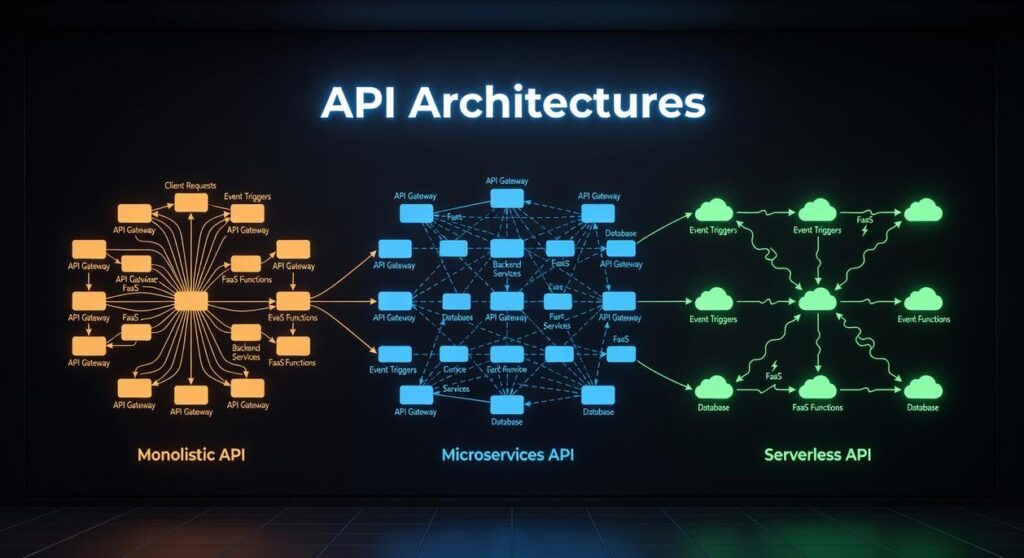
Before debating architectures, let’s ground this in what is an API: a set of rules that lets software systems communicate. Simple idea, powerful consequences.
REST APIs
REST (Representational State Transfer) is the crowd favorite. It’s stateless, meaning each request contains all the information needed—no server memory of prior calls. It uses standard HTTP methods like GET, POST, PUT, and DELETE. Most developers praise REST for flexibility and scalability.
Here’s the contrarian take: REST isn’t automatically “lightweight.” Poor endpoint design can bloat responses and create versioning chaos (yes, even in “clean” architectures). Discipline matters more than style.
SOAP APIs
SOAP (Simple Object Access Protocol) feels old-school—and many dismiss it. Yet its strict standards, built-in security (WS-Security), and formal error handling make it ideal for enterprise systems handling financial or healthcare data. Rigidity, in this case, is a feature.
GraphQL
GraphQL flips the script by letting clients request exactly the data they need—nothing more, nothing less. This reduces over-fetching and boosts performance. Still, without query controls, it can strain servers.
| API Type | Strength | Tradeoff |
|---|---|---|
| REST | Scalable, flexible |
Over-fetching |
| SOAP | Strong security | Complexity |
| GraphQL | Precise queries | Server load |
Why APIs are the Engine of Modern Innovation
If you’ve ever wondered what is an API in the section once exactly as it is given, let’s clarify. An API (Application Programming Interface) is a set of rules that lets different software systems talk to each other. Think of it like a waiter taking your order to the kitchen and bringing food back (no chef visit required).
Enabling Integration
APIs connect separate systems. A travel site, for example, uses airline, hotel, and car rental APIs to display options in one dashboard. You see one screen; behind it, multiple services exchange data in real time.
Accelerating Development
Developers reuse tools instead of rebuilding them. Payment APIs like Stripe or mapping APIs like Google Maps add complex features fast, saving months of work.
Fostering New Platforms
Some companies exist purely to connect APIs. Zapier links apps together, automating workflows and optimizing systems efficiently.
Mastering APIs for Smarter System Integration
You came here to finally understand what is an API exactly as it is given and how it fits into modern software systems. Now you have a clear picture of how APIs connect platforms, streamline communication, and power everything from mobile apps to machine learning frameworks.
The real pain point isn’t just defining APIs — it’s knowing how to use them effectively without wasting time, breaking integrations, or slowing down your system. When APIs are misunderstood, performance suffers, security risks increase, and innovation stalls.
Now that your intent is satisfied and the confusion is cleared up, your next step is simple: start applying this knowledge to evaluate your current integrations, optimize inefficient endpoints, and explore emerging API-first platforms that can scale with your goals.
If you’re tired of patchwork integrations and underperforming systems, take action today. Explore proven optimization strategies, leverage modern API frameworks, and follow insights trusted by thousands of tech professionals who rely on our deep-dive breakdowns. Stay ahead of the tech curve — start building smarter, faster, and more connected systems now.